
Coweta County Arrest Records and Charge Records
Arrest records and court charge records answer different questions in Coweta County. The sheriff side can show a person, arrest date, booking agency, arresting agency, primary charge, bond status, and release fields when those labels are available through Police-to-Citizen. The court side begins when the state files a charge in the right court. Superior Court handles felony case files. State Court handles misdemeanor criminal cases, traffic matters, and State Court civil matters. Magistrate Court may be involved in warrants, first appearances, and early criminal process.
A booking entry is not the full criminal case. It can help identify the arrest and the alleged offense, but the filed charge, court dates, motions, plea, disposition, and sentence are court records. The custody and jail side is better handled through the Coweta County inmate search, while the complete case file and outcome belong with Coweta County criminal court records. Court charges after arrest should be checked against the clerk docket or prosecutor office because a charge can be amended, reduced, dismissed, or replaced by a grand-jury indictment.
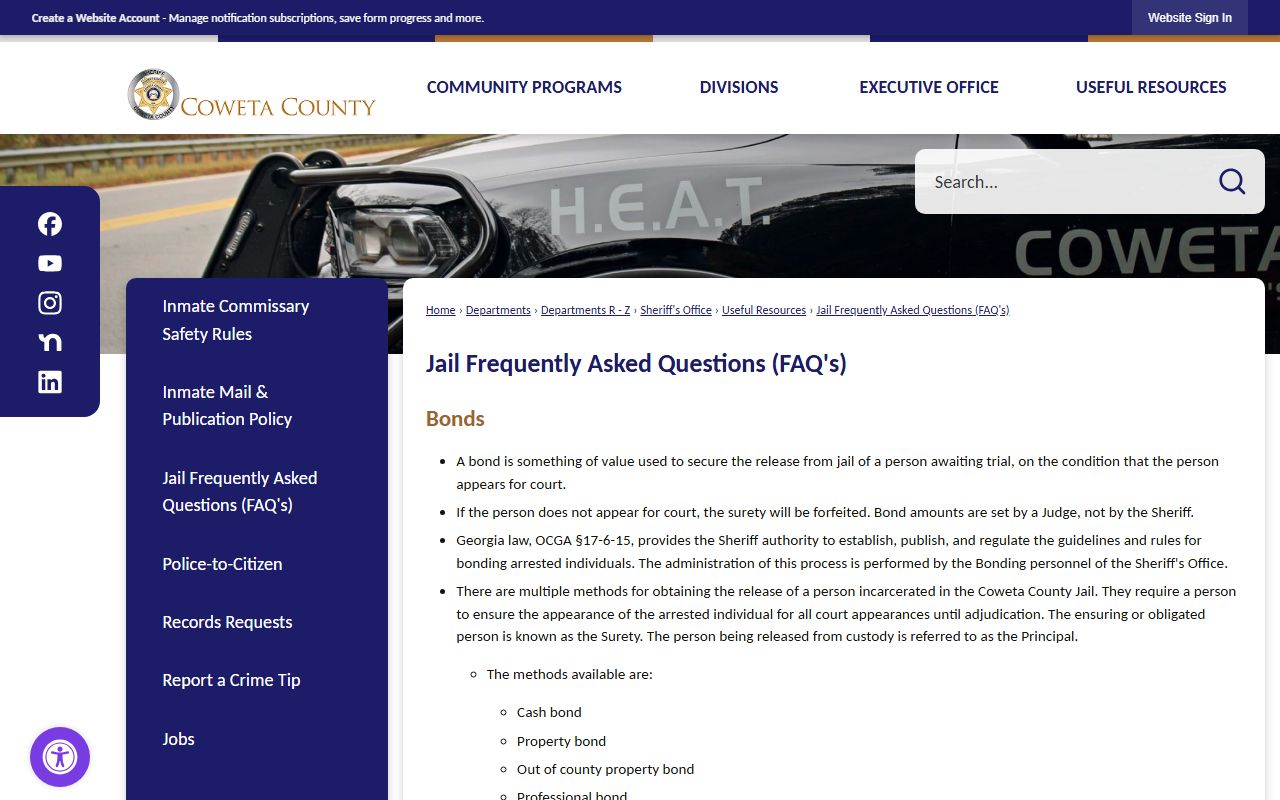
The Coweta County Jail FAQ is one official source for custody and bond rules tied to arrest records.
Find Coweta County Arrest Records and Charges
Start with the channel that matches the fact being checked. For a recent arrest or booking fact, use the Coweta County Sheriff's Office Police-to-Citizen tools and the jail contact channel. For filed court charges, use the Superior Court or State Court case-management search, depending on whether the charge is a felony, misdemeanor, or traffic offense. The Tyler court search tells users to try all spelling variations of names, which matters for initials, suffixes, hyphenated names, and data-entry variants.
- Identify whether the question is about booking, bond, the filed charge, or the final case outcome.
- Use the Police-to-Citizen inmate or recent-arrests route for custody facts and arrest labels.
- Search the Superior Court or State Court docket by party name or case number for filed charges.
- Compare each charge description, statute, bond field, court, and status to the clerk record.
- Use NextRequest or contact the correct office if the portal is incomplete or the record is restricted.
The Coweta Police-to-Citizen inmate catalog is the official roster route tied to many arrest-record searches.
Coweta County Charges After Arrest
After an arrest, the prosecutor decides what charge should be filed. In Coweta County, District Attorney John Herbert "Herb" Cranford Jr. handles felony and other state criminal matters for the Coweta Judicial Circuit. For State Court misdemeanors and traffic or non-traffic misdemeanors, Solicitor-General Amy Godfrey prosecutes cases in State Court. A filed charge may use an accusation, indictment, complaint, citation, or related charging document. The label depends on the court, offense level, and charging path.
The prosecutor role matters because an arrest label is not always the final filed charge. Officers may book a person under one primary charge, but the District Attorney or Solicitor-General may file a different charge, add counts, decline prosecution, or move forward after further review. For felony cases, grand-jury indictment can become the formal charging document. For misdemeanors, an accusation is common. For warrant and first-appearance matters, Magistrate Court may show early process before the case moves into State Court or Superior Court.
| Charging Document | Common Coweta Use | What It Starts |
|---|---|---|
| Complaint or warrant paperwork | Early arrest, warrant, or first-appearance process, often through Magistrate Court | Initial criminal process and bond review |
| Accusation | State Court misdemeanor and some non-indictment criminal filings | A filed criminal case with prosecutor-approved charges |
| Indictment | Felony prosecution after grand-jury action in Superior Court | The formal Superior Court felony charge record |
The Coweta P2C Recent Arrests route is useful for the arrest side because its exposed labels include arrest location, officer, case number, charge, bond type, and bond amount.
Coweta County Charge Status
Charge status is the part of a Coweta County court charge record that shows whether the state is still pursuing the count. A status can change as evidence is reviewed, as plea talks occur, or as the prosecutor files a different charge. A person may have several charges from one arrest, and each charge can have a separate bond, docket number, status, and final disposition. That is why a single arrest record should not be read as a conviction or as the whole case outcome.
| Status | What It Means | Where to Verify |
|---|---|---|
| Pending | The charge remains open and has not reached final disposition. | Superior Court or State Court docket |
| Amended or reduced | The prosecutor or court record reflects a changed charge, severity, or count. | Clerk docket and prosecutor filings |
| Dismissed | The charge was ended by court order or prosecutorial action. | Disposition entry and certified copy if needed |
| Nolle prosequi | The prosecutor chose not to proceed on that charge. | Filed prosecutor entry or court disposition |
Note: A public search result can lag behind clerk action, so use the clerk record or certified copy for legal proof.
Coweta County Charges vs Convictions
A charge is an allegation. A conviction is a final result after a guilty plea, finding of guilt, or verdict. Coweta County arrest records may show the charge used at booking, and court records may show charges filed later, but neither alone proves conviction unless the case record shows a final disposition. Georgia criminal-history and record-restriction rules also treat arrests, charges, and convictions differently.
| Question | Charge | Conviction |
|---|---|---|
| Record stage | Filed after arrest, citation, warrant, or prosecutor review | Entered after plea, trial verdict, or other final finding |
| Meaning | The state alleges an offense | The court has a final guilty outcome |
| Fields | Charge, statute, court, bond, warrant or case number | Disposition, sentence, probation, fines, and costs |
| Best source | Court docket and prosecutor filing | Final court order or certified clerk copy |
Coweta County Bond Fields
Bond appears in both custody and court-charge research because it connects the jail record to the first court events. Coweta County Jail materials describe cash bond, property bond, out-of-county property bond, and professional bond. The jail FAQ also states there is a non-refundable bond instrument fee and that card payments add a percentage fee. If several charges exist, more than one bond may be required. Bond does not decide guilt. It is a release condition tied to future court appearance.
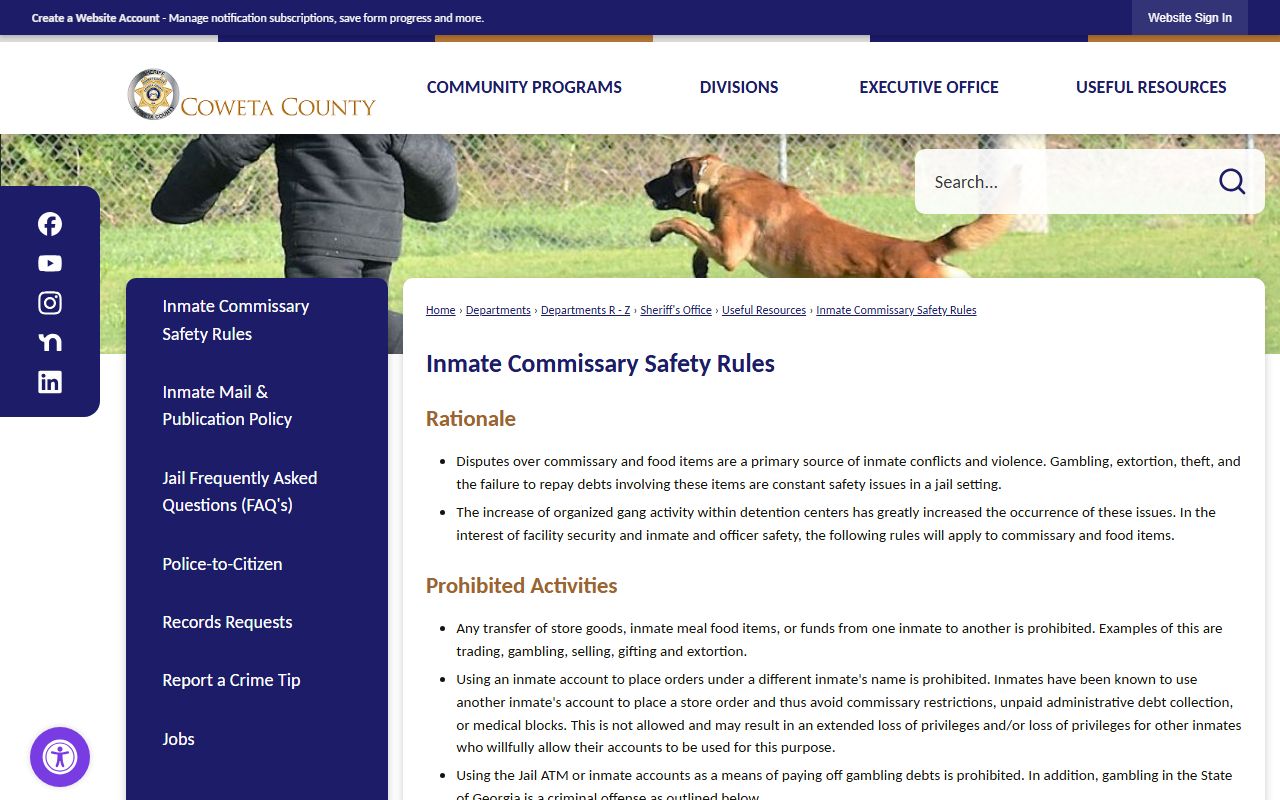
The Coweta inmate commissary safety rules are separate from charge status, but they show why custody rules should not be mixed with the court charge record.
Wanted Fields and Arrest Records
Wanted-person labels can overlap with arrest-record research, but they should be handled with care in Coweta County. The Police-to-Citizen software exposes Wanted Persons and Most Wanted routes, and the research found labels for agency, type, charge, bond amount, warrant number, address, age, race, and sex. The same research found the Coweta API reporting that WantedPersons and MostWantedPersons modules are not enabled. That means these routes should not be treated as a verified live warrant search.
The P2C Wanted Persons route is documented in the manifest, but Coweta warrant availability should still be verified by phone, court check, or lawful records request.
The P2C Most Wanted route follows the same caution because the module status controls whether public results are actually available.
Restricted Coweta County Charge Records
Georgia public access begins with the Open Records Act and court-record access rules, but not every arrest or charge detail is public. O.C.G.A. 50-18-70 treats public records as open unless a law limits access. O.C.G.A. 50-18-72 lists exemptions. Uniform Superior Court Rule 21 recognizes court access unless law or court procedure restricts it. For criminal-history restriction, O.C.G.A. 35-3-37 controls review, correction, and restriction.
Juvenile matters are different. Coweta Juvenile Court records are confidential, and selected documents may be obtained only by the minor, parents or legal guardians, and attorneys of record at the juvenile records counter with photo ID. Sealed warrants, adoption files, mental-health files, protected identifiers, and active-investigation material may also be withheld or redacted. For arrests after July 1, 2013, GBI directs record-restriction questions to the prosecutor. For older arrests, the person applies through the arresting agency.
Important: Record restriction limits public access in specific cases, but it does not promise removal of every government record.